

The Hidden Threat Beneath the Waves: Underwater Noise in the Mediterranean | REMPEC Regional Webinar – May 29, 2026
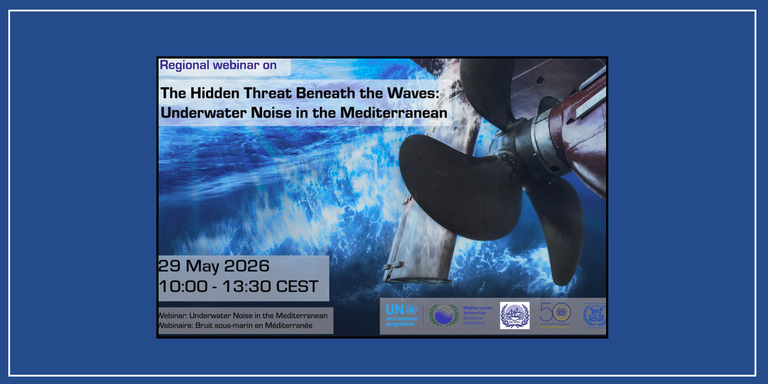
On 29 May 2026, the Regional Marine Pollution Emergency Response Centre for the Mediterranean Sea (REMPEC), in cooperation with its UNEP/MAP Partner OceanCare, organized the regional webinar “The Hidden Threat Beneath the Waves: Underwater Noise in the Mediterranean”.
The online event brought together experts from international organizations, regional institutions, academia, industry and civil society to discuss the impacts of anthropogenic underwater noise on marine life, ongoing developments at the international and regional levels, and opportunities to reduce underwater noise emissions from shipping and other human activities at sea.
Background: Why Underwater Noise Matters in the Mediterranean
Underwater noise has become an increasingly important environmental issue in the Mediterranean, where intense maritime traffic contributes to some of the highest background noise levels recorded globally. Commercial shipping, ferries and recreational vessels generate continuous underwater noise that can travel over long distances, altering the natural acoustic conditions on which many marine species depend for communication, navigation, foraging and other essential life functions.
The issue has been receiving growing attention at international and regional levels, particularly due to its impacts on whales, dolphins and other marine organisms that rely on sound for essential life functions. At the same time, practical solutions already exist to reduce underwater noise emissions, including operational measures such as vessel speed reduction and technical improvements to ship design and propulsion systems.
A Milestone for the Mediterranean: Adoption of Underwater Noise Indicators under IMAP
The webinar forms part of the implementation of Common Strategic Objective (CSO 7) of the Mediterranean Strategy for the Prevention, Preparedness, and Response to Marine Pollution from Ships (2022–2031), which calls for targeted action to address emerging issues, including the prevention and reduction of the impacts of underwater noise on marine life, through enhanced monitoring, cooperation, and the promotion of mitigation measures.
The event also supported the initial implementation of the newly adopted underwater noise indicators under the UNEP/MAP Integrated Monitoring and Assessment Programme (IMAP). At the 24th Meeting of the Contracting Parties to the Barcelona Convention (COP 24), held in December 2025, underwater noise indicators for both continuous and impulsive noise were formally adopted as Common Indicators, marking an important milestone for regional environmental monitoring and assessment. Contracting Parties have committed to progressively integrate these indicators into their national monitoring programmes.
REMPEC Regional Webinar on Underwater Noise in the Mediterranean
Experts from UNEP/MAP, IMO, EMSA, IWC, ACCOBAMS, Transport Canada and Quiet Oceans highlighted recent scientific advances, policy developments and technical solutions aimed at addressing underwater noise in the Mediterranean. Presentations explored the impacts of underwater noise on marine species, emerging regulatory frameworks, regional monitoring efforts and innovative tools for assessment and management.
Several important key messages emerged from the presentations and the discussions.
- Underwater radiated noise is increasingly recognized as a significant environmental pressure affecting marine species that depend on sound for communication, navigation and survival.
- Commercial shipping remains the primary source of continuous underwater noise, with propeller cavitation accounting for a significant share of emissions. Targeted mitigation measures could therefore deliver substantial reductions in overall noise levels.
- Vessel speed reduction was identified as one of the most effective short-term measures to reduce underwater noise, while also delivering greenhouse gas emission reductions. Other solutions include improved route planning, quieter vessel design and noise reduction at source.
- The webinar also stressed the importance of strengthening monitoring and assessment frameworks. The recent adoption of IMAP Common Indicators 26 and 27 represents a major step forward, while further work will focus on refining threshold values, improving assessment methodologies, increasing monitoring data and strengthening national capacities throughout the region.
- The importance of combining short- and long-term measures to effectively reduce underwater noise was emphasized. While many measures, particularly technological improvements, are expected to deliver results only over the longer term due to the time required for large-scale implementation, reducing vessel speed was reported to be the most effective measure for achieving short-term reductions.
- It was highlighted the value of existing tools and platforms such as NAVISON, NETCCOBAMS and OceanPlanner, which support monitoring, modelling and decision-making at both regional and local scales, including within marine protected areas.
A recurring theme throughout the webinar was the importance of regional cooperation. Progress towards achieving Good Environmental Status in relation to underwater noise will depend on coordinated action among Mediterranean States and continued collaboration between organizations such as UNEP/MAP, IMO, ACCOBAMS, EMSA and other partners.
The webinar demonstrated that a strong scientific, policy and technical foundation is already in place to address underwater noise in the Mediterranean. Building on this momentum, REMPEC, OceanCare and all other partners will continue supporting regional cooperation, monitoring efforts and practical mitigation measures to help ensure that both maritime activities and marine biodiversity can thrive in a quieter and healthier Mediterranean Sea.
Additional information:
- Download the webinar programme
- Watch the webinar recording through https://youtu.be/kASXWS9slpc
- Download the presentations through the links provided below;
- Underwater noise, its impacts on marine species and the main mitigation measures by Mr. Russell Leaper, Scientific Committee of the International Whaling Commission (IWC)
- The International Maritime Organization (IMO) relevant work on underwater radiated noise (the GloNoise project and the revised IMO guidelines on URN – MEPC.1/Circ.906/Rev.1 (2024) – and its associated action plan) by Ms. Sevtap Ozdogan, IMO’s GloNoise Project Manager
- The High Ambition Coalition for a Quiet Ocean and its role in advancing global cooperation on ocean noise reduction by Dr. Aurélie Cosandey-Godin, Policy Advisor, Marine Protection Policy, Transport Canada, Government of Canada;
- Recent developments under the UNEP/MAP Integrated Monitoring and Assessment Programme (IMAP), including the adoption of underwater noise indicators by Ms. Jelena Knezevic, Monitoring and Assessment Officer, Mediterranean Pollution Assessment and Control Programme (MED POL), UN Environment Programme /Mediterranean Action Plan (UNEP/MAP), Barcelona Convention Secretariat;
- Collaboration between UNEP/MAP and the Joint ACCOBAMS/ASCOBANS/CMS Noise Working Group on Mediterranean Underwater Noise Indicators under IMAP and the monitoring, modelling and assessment tool NETCCOBAMS by Mr. Alessio Maglio, Underwater Noise and Marine Mammal Consultant at SINAY - Member of the ACCOBAMS/ASCOBANS/CMS Noise Working Group;
- Monitoring, modelling and assessment of underwater noise in the Mediterranean, including innovative tools and platforms that support noise mapping, monitoring and management effort:
- NAVISON by Mr. Samy Djavidnia, Environment & Sustainability Senior Project Officer, European Maritime Safety Agency, European Union;
- Ocean Planner by Mr. Thomas Folegot, Founder and Director of Innovation, Quiet Oceans.